For SaaS and all types of technology startups, their business logic is entirely different from that of traditional brick-and-mortar counter sales. These firms must handle a range of unique financial tasks, including monthly recurring revenue (MRR), user churn rate, capitalization of R&D costs, and ultra-fast business expansion. However, many founders still use generic off-the-shelf bookkeeping solutions, which cannot align with the specific details of their operations.
To build a sustainable financial foundation that attracts investors and drives growth, customized accounting solutions are a necessity. The following passage will explain the 5 core reasons why such solutions are indispensable, and White Label Accounting Inc. is also able to provide relevant support.
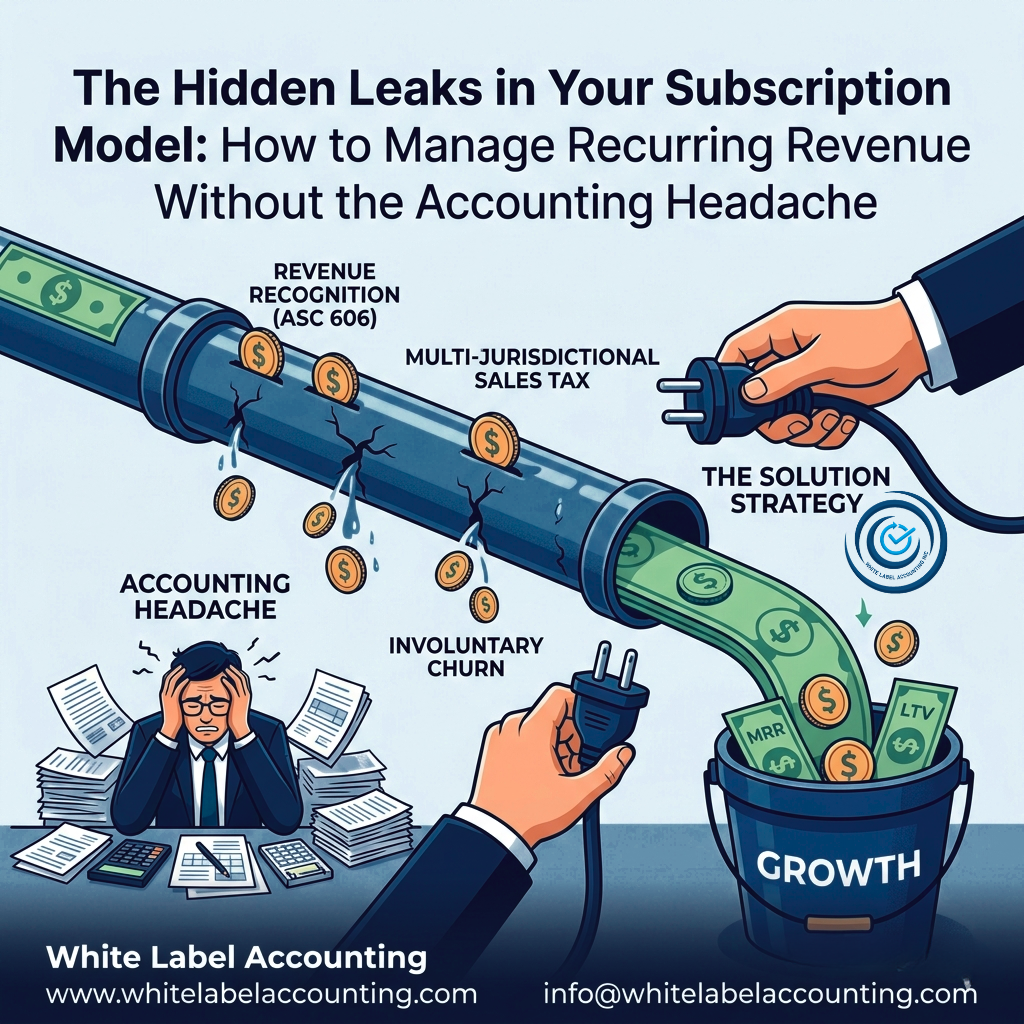
Mastering Complex Revenue Recognition (ASC 606)
SaaS industry practitioners must clarify their sector’s core accounting rules: cash received is not equivalent to recognized revenue.
If a customer prepays an annual subscription fee of US$1,200, standard accounting software tends to record the full amount in the first month, but under the ASC 606 standard, only US$100 may be recognized as revenue each month. Custom-built accounting setups can pre-configure deferred revenue plans.
Recording this revenue will distort monthly profitability and disrupt financial audits and investor due diligence.
Bridging the Gap Between Financials and SaaS Metrics
The authors of this paper propose that while the profit and loss (P&L) statement produced by traditional standard accounting is indispensable, it cannot fully reflect the complete operational picture of technology startups. To grasp an enterprise’s true operational health, it is necessary to focus on four dedicated operational metrics: customer acquisition cost (CAC), lifetime value (LTV), and monthly/annual recurring revenue (MRR/ARR).
This customized accounting framework can help startup founders clarify the customer acquisition impact of their marketing expenditures, verify the rationality of their unit economic model, and support core expansion decisions before they launch large-scale scaled operations.
Maximizing R&D Tax Credits
If you are the founder of a technology startup, even if you have invested large sums of money into research and development (R&D), you will most likely be unaware that engineer salaries, cloud computing costs, and prototyping fees are all eligible to be claimed for the R&D Tax Credit.
The generalized, broad categorization practices used by regular accountants will cause you to lose out on your application eligibility for this credit. By categorizing these expenses as Qualified Research Expenses (QREs) through customized bookkeeping, you can save tens of thousands of dollars in payroll taxes and extend your company’s operational runway.
Preparing for Investors and Fundraising (Investor-Ready Books)
If you are preparing to raise early-stage financing at the Seed round and Series A stages, you should be aware that angel investors and venture capital firms will conduct rigorous reviews of your company’s financial accounts. Their core requirements include GAAP-compliant financial records, accurate cohort analyses, and a clear grasp of your company’s burn rate.
Rough, unpolished financial reports will expose gaps in your internal management and control systems and push up investment risk. Our customized accounting solutions can help you meet these required standards, successfully pass due diligence, and complete your financing.
Building a Scalable Financial Infrastructure
If you are a SaaS or tech startup, have you run into financial bottlenecks while navigating between growth stages? When your monthly recurring revenue (MRR) rises from $10,000 to $500,000, your accounting requirements shift dramatically. Generic accounting systems are completely unable to support use cases involving multiple subscription tiers, global currencies, and usage-based pricing.
They also cannot integrate with automated billing tools such as Stripe and Charge bee, while frequent human errors further slow your expansion. White Label Accounting Inc. serves as your dedicated behind-scenes financial partner, offering ASC 606 compliance management and the development of robust, VC-appealing financial models to embed scalability into your financial infrastructure.
Visit whitelabelaccounting today to book an appointment, and build a custom financial backend tailored to your unique growth trajectory. A tech startup’s financial strategy should never be forced to fit a standardized, one-size-fits-all template.
Copyright © 2025 White Label Accounting Inc. All Rights Reserved | Developed by WITH U Technology Pvt. Ltd.