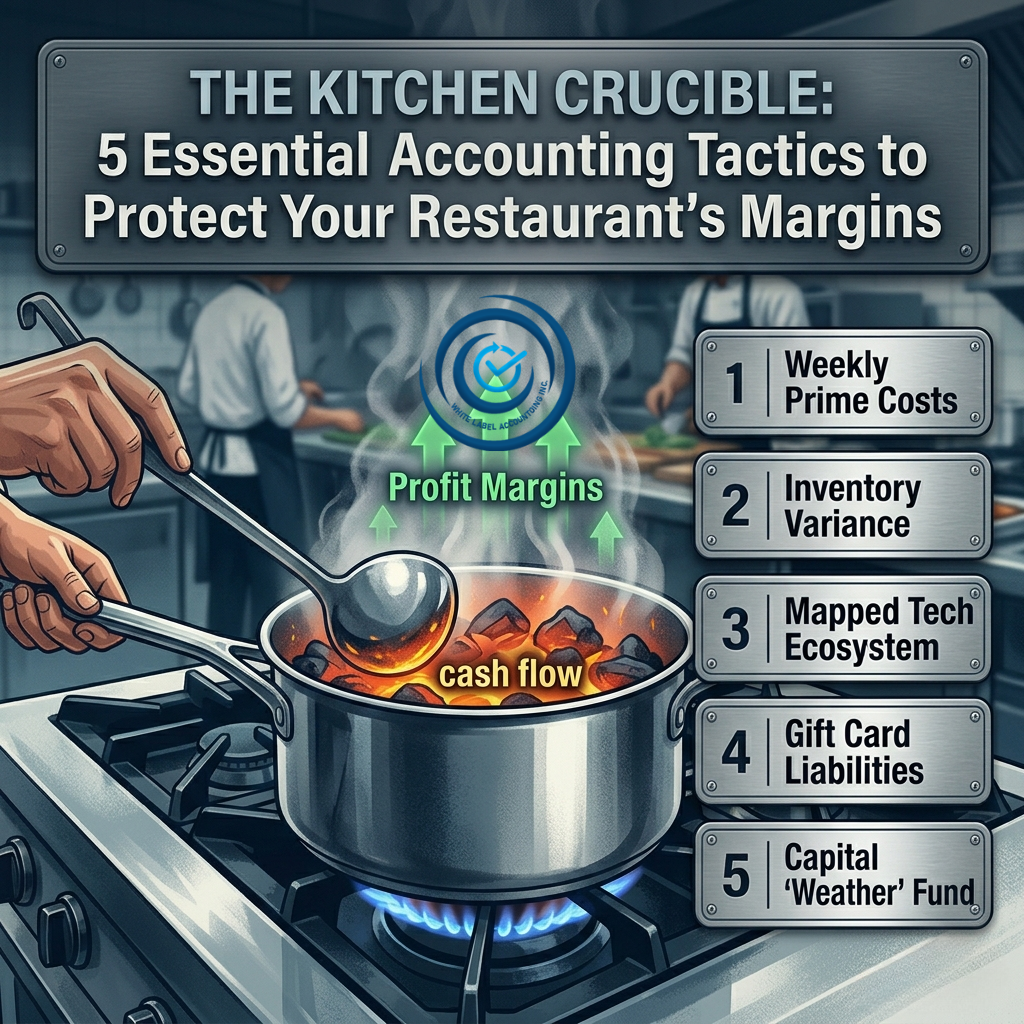
Managing a restaurant or food business is the ultimate balancing act. Between tracking inventory that spoils in days, managing volatile ingredient costs, and keeping a fluctuating front-of-house schedule organized, the back-of-house finances often get pushed to the back burner.
However, in an industry where margins are notoriously razor-thin—typically hovering between 3% and 5%—strict financial control isn't just a chore. It’s the secret ingredient to longevity.
To help stabilize your cash flow, protect your margins, and set up your food business for sustainable growth, here is a practical framework of essential accounting tips tailored specifically for restaurant owners.
In the food industry, waiting for a monthly Profit & Loss (P&L) statement to check your financial health is an invitation to disaster. A spike in food waste or a few over-scheduled, slow shifts can wipe out an entire month’s profit in a matter of days.
Instead, you need to track your Prime Costs on a weekly basis. Your Prime Cost is the combination of two critical numbers:
Cost of Goods Sold (COGS): The total cost of ingredients, beverages, and packaging used to create your menu items.
Labor Costs: Total wages, payroll taxes, benefits, and insurance for both front-of-house (FOH) and back-of-house (BOH) staff.
The Golden Ratio: For most profitable independent restaurants, Prime Costs should hover between 55% and 65% of total sales. If this number creeps past 70%, your business is likely losing money after factoring in fixed overhead like rent and utilities.
Food is quite literally cash sitting on your shelves. If inventory isn't strictly tracked, it can quickly disappear through spoilage, over-portioning, or theft. The most accurate way to manage this leak is by comparing Theoretical COGS against Actual COGS.
Theoretical COGS: What your food cost should be based on your recipe cards and sales data (e.g., if you sold 100 steaks, exactly 100 steaks' worth of beef should be gone from the kitchen).
Actual COGS: What you actually spent based on physical inventory counts taken at the beginning and end of the week.
The difference between these two numbers is called variance (or waste). A healthy, tight ship aims for a variance under 2%. If your variance is higher, it’s an immediate signal to investigate kitchen portion control, look at how "compted" or promotional meals are being tracked, or check for sudden vendor pricing changes.
Manual data entry is prone to human error and eats up valuable hours you could spend on the floor or developing new menu items. Modern food businesses rely on a three-tier cloud accounting ecosystem that integrates seamlessly to provide a daily snapshot of finances.
|
System Tier |
Primary Function |
Ideal Setup Examples |
|
Point of Sale (POS) |
Tracks real-time revenue, item sales, and employee clock-ins. |
Toast, Square, Clover |
|
Inventory & Invoice Management |
Digitizes vendor invoices, updates ingredient prices, tracks stock. |
MarginEdge, Restaurant365 |
|
Cloud Accounting Engine |
Houses the general ledger, handles bank reconciliations, generates P&Ls. |
QuickBooks Online, Xero |
By ensuring your POS maps directly to your accounting software, daily sales summaries, sales tax liabilities, and credit card processing fees populate automatically. This keeps your books clean, real-time, and completely audit-ready.
A common pitfall for new food businesses is treating gift card sales or private event deposits as immediate revenue.
When a customer buys a $100 gift card, your business hasn't earned that revenue yet; you have essentially accepted a interest-free cash loan from the customer.
Initial Sale: Book the $100 as a Liability (Deferred Revenue) on your Balance Sheet.
Redemption: Move the $100 from Liabilities to Revenue on your Income Statement only when the customer returns and actually eats the food.
Treating gift cards as instant revenue artificially inflates your income for the month. Worse, it creates severe cash flow shortages down the road when those cards are finally redeemed for physical food and labor without any new money entering the register.
Because restaurant revenue shifts violently with seasons, holidays, and even a string of rainy days, holding a cash buffer is essential. A single broken commercial refrigerator or walk-in compressor can cost thousands of dollars in emergency repairs and ruined inventory.
Aim to maintain a working capital reserve equal to 2 to 4 weeks of fixed operational expenses (rent, payroll, utilities). Keep this fund in a separate, liquid business savings account so it isn't accidentally absorbed by your daily or weekly food orders.
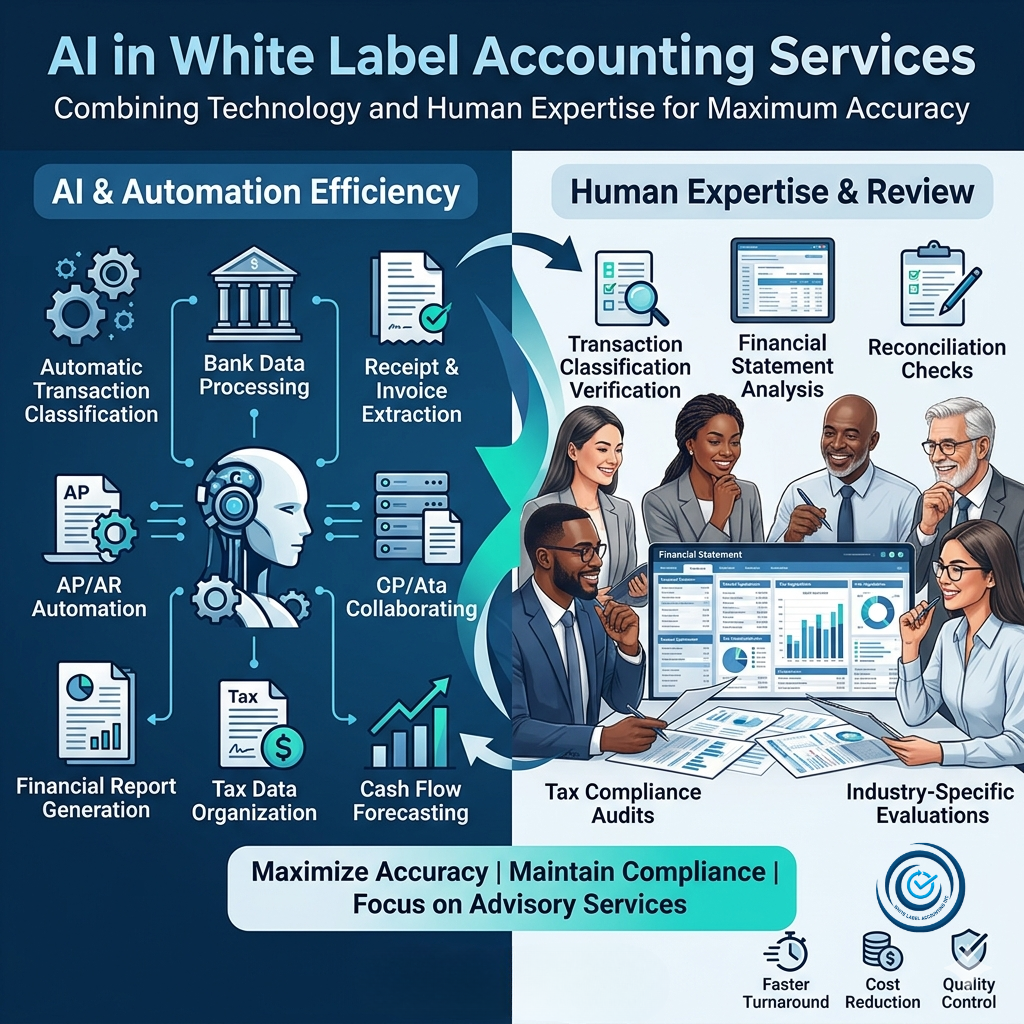
As a food business successfully scales from a single location to multiple units, food trucks, or a dedicated catering arm, managing the books in-house quickly becomes a dangerous bottleneck. Many restaurant groups transition to a white-label accounting partnership to handle this growth cleanly.
A white-label financial team handles the heavy lifting of back-of-house tasks behind the scenes:
Processing payroll across multiple locations and tax jurisdictions.
Reconciling daily merchant processor and delivery-app deposits.
Tracking multi-vendor accounts payable to ensure you never miss an early-payment discount.
This structure provides your growing business with enterprise-level financial expertise and delivers clean, standardized reporting, all while reducing overhead costs compared to hiring a full-time, internal controller. Ultimately, it keeps your business compliant and scalable, leaving you completely in control of what matters most: the hospitality, the food, and the guest experience.

Copyright © 2025 White Label Accounting Inc. All Rights Reserved | Developed by WITH U Technology Pvt. Ltd.