The subscription economy is booming. Whether you run a SaaS platform, a digital media hub, or an online agency, recurring revenue is the holy grail. It provides predictable cash flow, scales beautifully, and boosts company valuation.
But beneath the surface of every thriving subscription business lies a complex web of financial compliance.
Managing recurring revenue isn’t as simple as billing a credit card every 30 days. From deferred revenue to involuntary churn, online services face unique bookkeeping hurdles that can quickly turn a dream business model into an accounting nightmare.
Let’s break down the hidden challenges of managing subscription revenue and how you can protect your bottom line.
One of the most frequent mistakes online services make is counting cash collected as revenue earned.
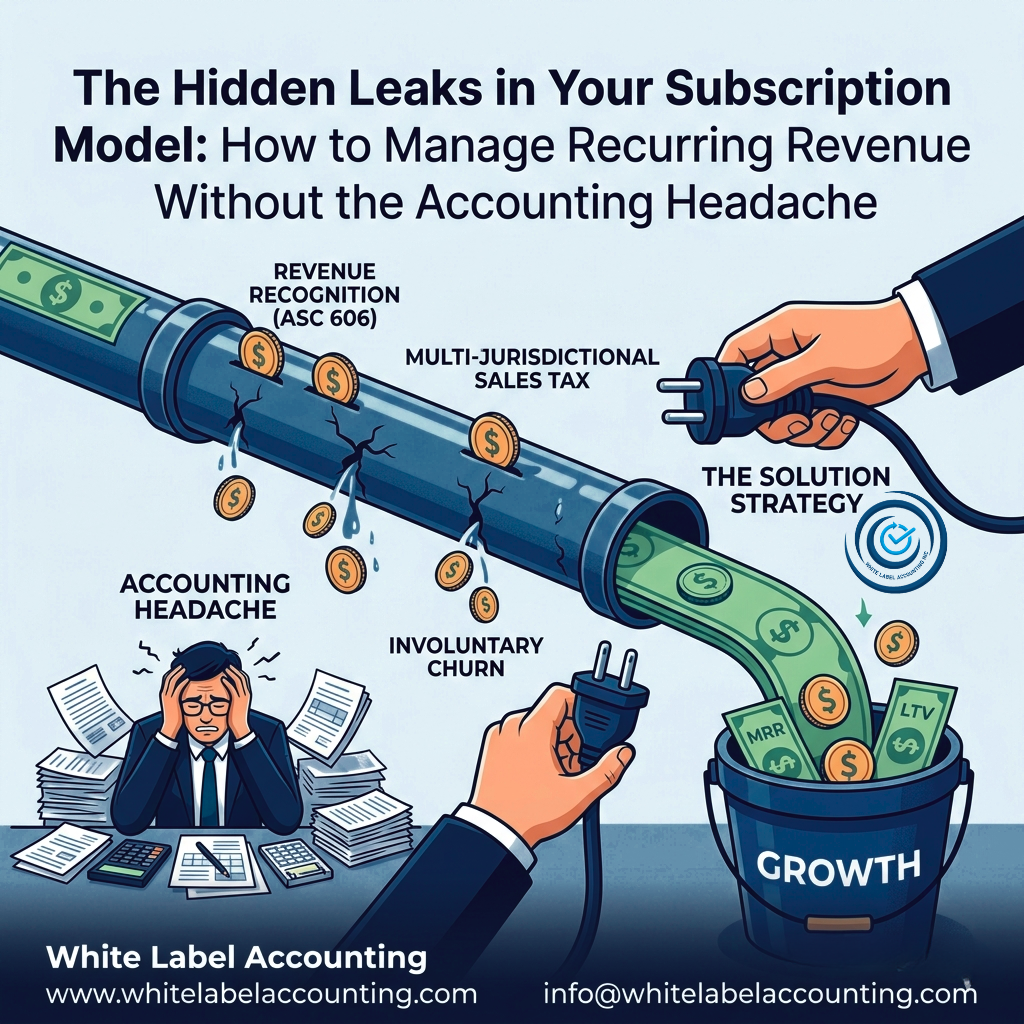
If a customer pays you $1,200 for an annual subscription on January 1st, you have not earned $1,200 in January. Legally and according to standard accounting principles (like ASC 606), you have only earned $100. The remaining $1,100 is considered deferred revenue—a liability on your balance sheet that you recognize month-by-month as the service is delivered.
Why it matters: If you recognize all that cash upfront, your books will show massive profit spikes followed by months of artificial "losses," making it impossible to get an accurate view of your business’s health or secure investor funding.
Traditional financial statements (like your standard P&L) don't tell the whole story for online service models. To scale effectively, you must marry traditional accounting data with active SaaS metrics.
Make sure your financial tracking isolates these key indicators:
Monthly Recurring Revenue (MRR): The predictable core revenue your business generates each month.
Churn Rate (Customer & Revenue): The percentage of users or dollars lost over a given period.
Customer Acquisition Cost (CAC) vs. Lifetime Value (LTV): A healthy business model typically looks for an LTV that is at least 3 times greater than the CAC.
When you sell physical goods, tax is largely tied to your physical location. When you sell digital services or software, you enter the wild world of digital tax nexus.
Between the Wayfair decision in the US and VAT/GST regulations globally, you may owe sales tax to states or countries where you don't have a physical footprint, simply because you crossed a specific threshold of transactions or revenue. Failing to track and automate this can lead to massive back-tax penalties down the road.
Are your books currently built to handle scale? Review this checklist to see where your operations stand:
|
Recurring Revenue Challenge |
The Solution Strategy |
|
Involuntary Churn |
Implement automated dunning systems (failed payment retries and reminders) to recover up to 10% of lost revenue. |
|
Prurated Billing |
Ensure your billing platform is seamlessly synced to your ledger to handle mid-month upgrades and downgrades automatically. |
|
Payment Gateway Fees |
Correctly categorize Stripe or PayPal processing fees as an expense, rather than just recording the "net" cash deposited. |
You built your online service to innovate, disrupt, and serve your clients—not to spend your weekends reconciling deferred revenue schedules and calculating sales tax thresholds.
That’s where we come in. At White Label Accounting, we act as your invisible back-office finance powerhouse. We handle the technicalities of subscription accounting, compliance, and growth metrics under your own banner, letting you focus entirely on scaling your platform.
Stop guessing your actual cash position. Let the experts streamline your recurring revenue backend.
Ready to clean up your subscription books?
Visit Us: www.whitelabelaccounting.com
Get in Touch: info@whitelabelaccounting.com




Copyright © 2025 White Label Accounting Inc. All Rights Reserved | Developed by WITH U Technology Pvt. Ltd.