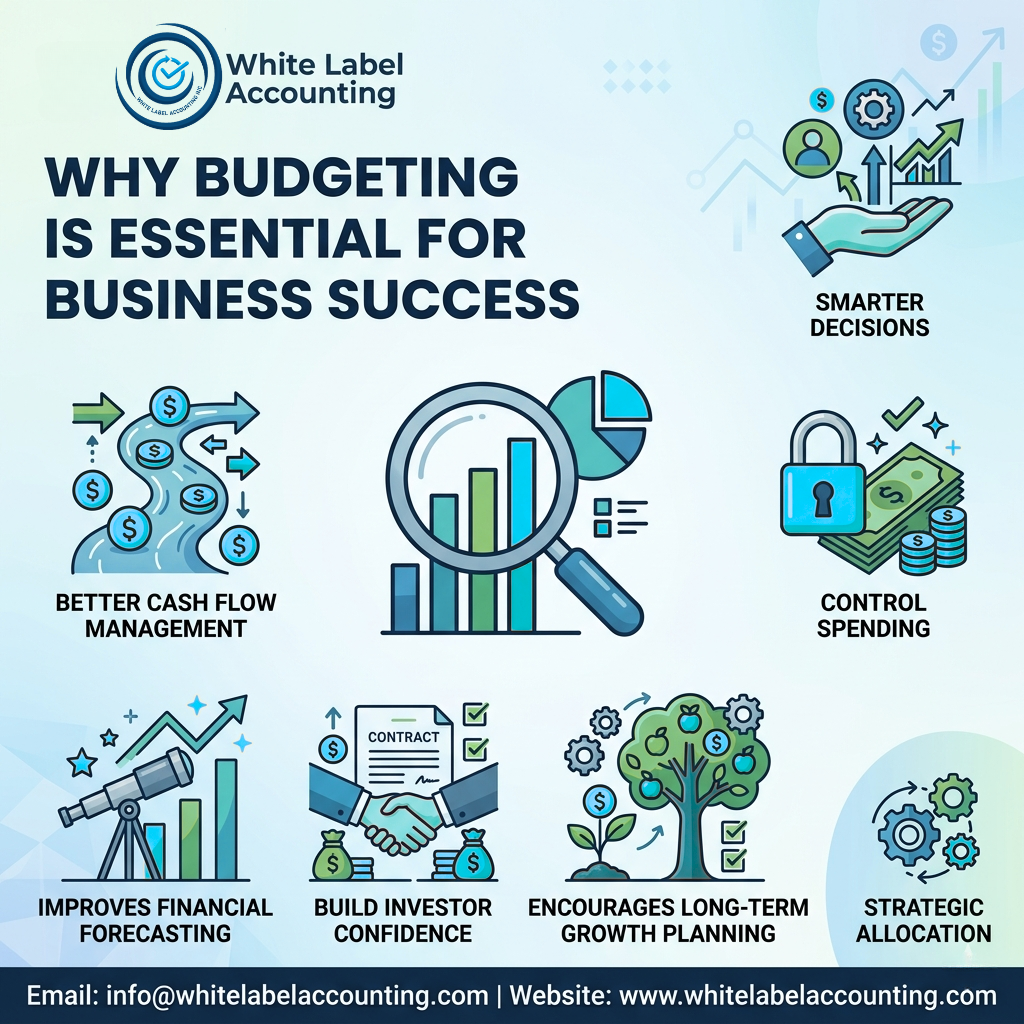
In today’s fast-moving business environment, success is no longer determined only by how much revenue a company generates. Sustainable growth depends on how effectively a business manages its finances, plans for uncertainty, and allocates resources strategically. This is where budgeting becomes one of the most powerful tools in modern business management.
Many businesses view budgeting as a restrictive financial exercise focused only on limiting spending. In reality, a well-structured budget acts as a roadmap for growth, profitability, and stability.
At White Label Accounting, we work with businesses that often discover their biggest financial improvements not through increasing sales alone, but through better financial planning and budgeting discipline.
Every successful business needs a financial plan that aligns with its goals. Budgeting creates structure by helping businesses:
estimate future revenue,
plan operational expenses,
allocate resources efficiently,
and prepare for financial challenges.
Without a budget, businesses often make reactive decisions instead of strategic ones. Spending becomes unpredictable, cash flow weakens, and long-term planning becomes difficult.
A budget transforms financial management from guesswork into measurable decision-making.
One of the most common reasons businesses struggle financially is poor cash flow management rather than lack of sales.
A budget helps businesses:
forecast incoming and outgoing cash,
identify potential shortages early,
manage payment schedules,
and maintain operational stability.
When companies understand where cash is moving each month, they are better prepared to:
cover operational costs,
manage payroll,
pay suppliers on time,
and invest confidently in growth opportunities.
Businesses that actively budget are often more resilient during slower revenue periods or market uncertainty.
Every business decision has a financial impact.
Whether hiring new employees, launching marketing campaigns, expanding operations, or purchasing equipment, budgeting helps leaders evaluate:
affordability,
return on investment,
and financial risk.
Instead of making emotional or impulsive decisions, businesses can rely on financial data and forecasts.
Modern accounting platforms like QuickBooks, Xero, and Zoho Books make budgeting more accurate by providing real-time financial visibility and reporting.
As businesses grow, expenses can increase quietly over time.
Subscriptions, operational inefficiencies, duplicate services, and unmanaged overhead often reduce profitability without immediate visibility.
A structured budget creates accountability by helping businesses:
monitor expenses regularly,
compare actual spending against planned spending,
and identify areas of waste.
This doesn’t mean businesses should avoid spending. It means spending should align with business priorities and measurable outcomes.
Budgeting is closely connected to forecasting.
A strong budgeting process helps businesses estimate:
future revenue,
operational costs,
staffing needs,
investment requirements,
and profitability targets.
Financial forecasting becomes especially important during:
expansion,
seasonal fluctuations,
economic uncertainty,
or investment planning.
Businesses with accurate forecasts are generally better prepared to adapt quickly when market conditions change.
Investors and financial institutions want to see evidence of financial discipline before providing funding.
A business with organized budgets and financial projections demonstrates:
operational maturity,
strategic planning,
financial awareness,
and risk management capability.
Clear budgeting reports also improve transparency during:
loan applications,
investor presentations,
partnership negotiations,
and business valuations.
Businesses often focus heavily on short-term operations while neglecting long-term strategy.
Budgeting helps organizations plan for:
expansion,
technology investments,
hiring,
product development,
and market growth.
Instead of reacting to immediate financial pressures, businesses can proactively prepare for future opportunities.
Long-term budgeting creates financial stability that supports sustainable growth rather than unpredictable expansion.
Financial uncertainty creates pressure for business owners and leadership teams.
Without budgeting:
unexpected expenses become crises,
profitability becomes unclear,
and financial planning feels overwhelming.
A structured budgeting process improves visibility and control, helping businesses make decisions with greater confidence.
When leadership understands the financial position of the company clearly, operations become more organized and less reactive.
One of the most valuable aspects of budgeting is performance measurement.
Businesses can compare:
actual revenue vs projected revenue,
actual expenses vs planned expenses,
and profitability targets vs real performance.
This analysis helps identify:
operational inefficiencies,
underperforming areas,
growth opportunities,
and financial risks early.
Management reporting combined with budgeting creates stronger accountability across departments and teams.
Today’s businesses no longer need to rely entirely on spreadsheets and manual calculations.
Cloud accounting and financial management tools allow businesses to:
automate reporting,
monitor budgets in real time,
generate forecasts quickly,
and improve financial accuracy.
Integrated accounting systems provide business owners with immediate access to financial insights, helping them make faster and smarter decisions.
Many businesses struggle with budgeting because they lack:
financial expertise,
structured reporting systems,
or dedicated accounting support.
Professional accounting and outsourced finance teams can help businesses:
create realistic budgets,
improve forecasting accuracy,
manage cash flow,
and establish stronger financial controls.
An effective budgeting strategy is not just about reducing expenses — it is about creating a financial structure that supports growth and profitability.
Budgeting is no longer just an accounting task handled at the end of the financial year. It is a critical business strategy that influences every aspect of operations, growth, and decision-making.
Businesses that budget effectively are often better equipped to:
manage uncertainty,
improve profitability,
scale sustainably,
and make confident financial decisions.
In a competitive business landscape, financial clarity can become a major advantage.
At White Label Accounting, we help businesses strengthen financial management through smarter accounting, reporting, and budgeting support designed for modern business growth.

Copyright © 2025 White Label Accounting Inc. All Rights Reserved | Developed by WITH U Technology Pvt. Ltd.