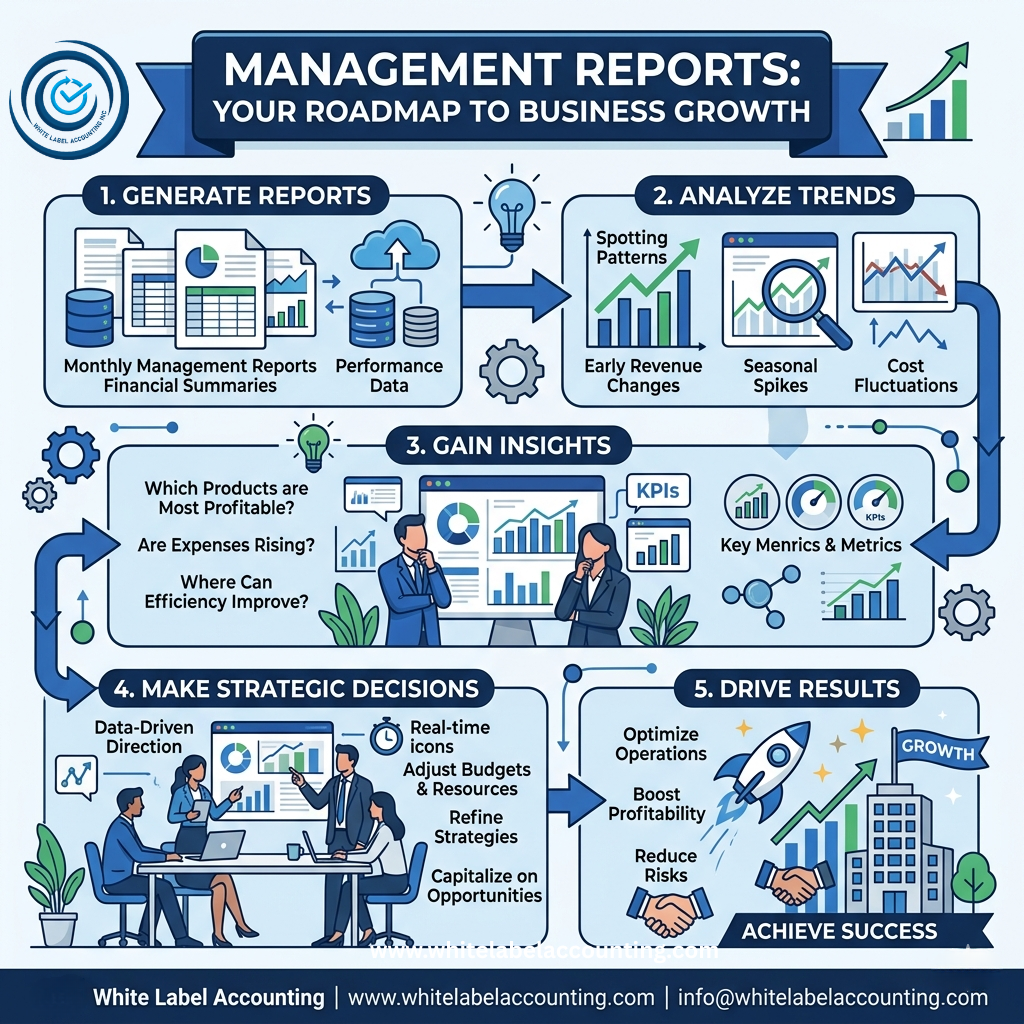
In a world where businesses generate more data than ever before, success doesn’t come from having information—it comes from understanding it. This is where management reports step in, acting as a bridge between raw numbers and real business decisions.
For modern businesses, especially those navigating competitive markets, management reporting is no longer a routine task. It’s a strategic tool that reveals patterns, highlights opportunities, and predicts what’s next.
Management reports are often seen as financial summaries—but their real value lies in storytelling. Each report answers critical questions:
Are revenues growing or plateauing?
Which services or products are most profitable?
Where are costs increasing—and why?
How does performance compare over time?
When interpreted correctly, these reports transform static data into dynamic insights that guide smarter decisions.
One of the biggest advantages of management reporting is the ability to identify trends early. Instead of reacting to changes, businesses can anticipate them.
For example:
A gradual increase in expenses may signal inefficiencies
Seasonal sales patterns can help forecast demand
Declining margins might indicate pricing or cost issues
By tracking these patterns consistently, businesses gain a proactive edge rather than a reactive one.
Traditional reporting methods often lag behind reality. By the time reports are reviewed, opportunities may already be lost.
Modern reporting tools offer:
Real-time dashboards
Automated data updates
Visual analytics (charts, graphs, KPIs)
This allows business leaders to make quick, informed decisions—whether it’s adjusting budgets, reallocating resources, or refining strategies.
Management reports don’t just highlight trends—they measure how well your business strategy is working.
Key performance indicators (KPIs) such as:
Revenue growth
Profit margins
Customer acquisition costs
Operational efficiency
…help businesses evaluate whether they are on track or need to pivot. This alignment ensures that strategy is not just planned, but continuously optimized.
Raw financial data can be overwhelming. Management reports simplify complexity by presenting:
Clear summaries of financial health
Department-wise performance insights
Comparative analysis (month-on-month, year-on-year)
This structured approach helps decision-makers quickly grasp what matters most, without getting lost in spreadsheets.
Many businesses struggle to extract meaningful insights from their data—not because they lack information, but because they lack the right expertise.
Partnering with specialists like White Label Accounting enables businesses to:
Access professionally prepared management reports
Gain expert interpretation of financial data
Focus on strategy rather than report creation
Outsourced accounting professionals bring both accuracy and analytical depth, ensuring reports are not just created—but understood.
The true value of management reporting lies in action. Insights alone are not enough—businesses must use them to:
Optimize operations
Improve profitability
Identify growth opportunities
Reduce risks
When reports are used effectively, they become a roadmap for continuous improvement.
Management reports are no longer just internal documents—they are strategic assets. In the hands of forward-thinking businesses, they unlock trends, drive innovation, and create a competitive advantage.
At www.whitelabelaccounting.com, we believe that every number tells a story. The key is knowing how to read it—and more importantly, how to act on it.

Copyright © 2025 White Label Accounting Inc. All Rights Reserved | Developed by WITH U Technology Pvt. Ltd.