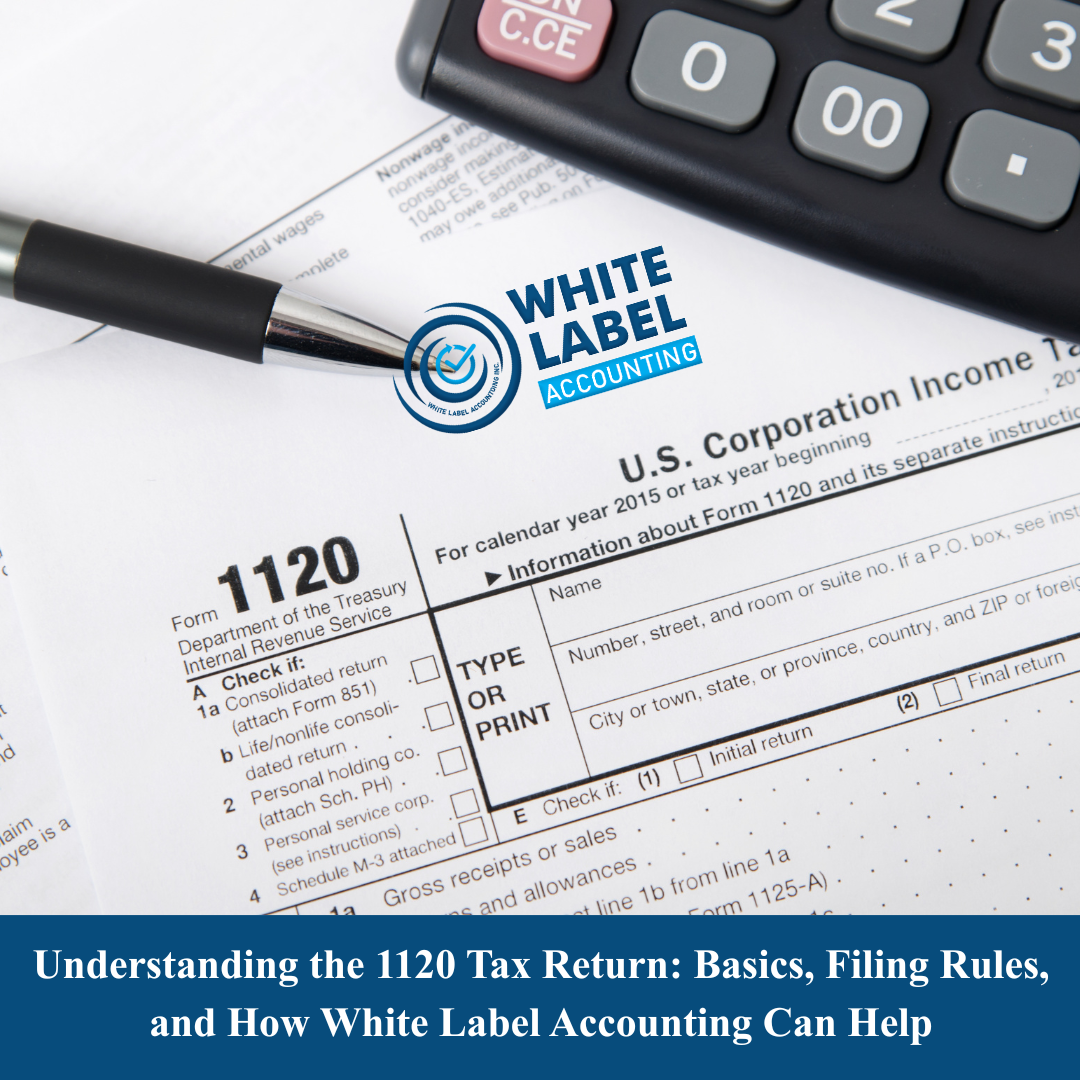
Filing corporate taxes can be challenging, especially when dealing with complex forms like the IRS Form 1120. For U.S. corporations, this form is crucial for accurately reporting income, claiming deductions, and paying the correct amount of federal taxes.
At White Label Accounting, we specialize in helping businesses navigate the complexities of corporate tax filing—ensuring IRS compliance, accurate reporting, and maximum tax benefits.
In this guide, we’ll explain the basics of Form 1120, key filing rules, deadlines, and how our experts can simplify the process for your business.
Form 1120, also known as the U.S. Corporation Income Tax Return, is used by C corporations to report their annual income, deductions, credits, and tax payments. It ensures that corporations meet their federal tax obligations each year.
When a corporation operates as a separate taxable entity, that entity must determine whether it qualifies as a “1120 filer” — in other words, a company that needs to file Form 1120. Normally, who files Form 1120 are domestic C corporations (or other associations electing to be treated as corporations under federal tax law) that report their income, deductions, credits, and tax liability on the return. If your business falls into that classification, you will need the proper documentation, attach the required schedules, and file the return by the due date — and working with a service such as White Label Accounting can help ensure compliance and accuracy throughout this process.
While Form 1120 is the most common for standard corporations, there are several variations for different entity types:
Form 1120 (C Corp) – For standard corporations reporting income, losses, and credits.
Form 1120-H – For homeowner associations reporting financial activity.
Form 1120-C – For certain cooperatives, such as agricultural organizations.
Key Components of the 1120 Tax Return
To file Form 1120 correctly, corporations must understand its main components:
Income Reporting
Report all income, including gross receipts, sales, dividends, and interest.
Deductions and Credits
Deduct eligible expenses such as employee wages, rent, and operating costs. Proper deductions can significantly lower your total tax liability.
Estimated Tax Payments
Corporations must make quarterly estimated tax payments to avoid penalties using the 1120-ES Estimated Tax Form.
Extension Options
Need more time to file? Use Form 7004 (1120 Tax Extension) to extend your deadline by six months. However, remember that this doesn’t extend the time to pay any taxes owed.
For tax year 2024, Form 1120 is generally due by April 15, 2025.
If your corporation operates on a fiscal year rather than a calendar year, the due date is the 15th day of the fourth month following the end of your fiscal year.
Missing deadlines can lead to penalties, so filing on time—or requesting an extension—is essential.
Depending on your business type and activities, additional forms may be required:
Form 1120 Tax Rate Schedule – Determines applicable corporate tax rates.
Form 1120-G – For certain government entities.
Form 1120-H Instructions – Guidance for homeowner associations.
State-specific Forms – For example, Missouri Form 1120 for state-level filing.
Filing corporate tax returns can be complex. Here are a few common issues businesses face:
Complex Tax Calculations
Determining the correct Form 1120 tax rate, deductions, and credits can be tricky without expert help.
Accuracy in Reporting
Errors in income or expense reporting can trigger IRS audits or penalties.
Deadline Management
Missing filing or payment deadlines can result in interest and penalties.
How White Label Accounting Can Help with Form 1120 Filing
At White Label Accounting, we make corporate tax filing simple, accurate, and stress-free. Here’s how we can support your business:
Accurate Preparation and Filing
Our tax professionals handle every step of your 1120 filing—from calculating tax liability to ensuring all deductions are applied correctly.
Proactive Tax Planning
We help your business plan for taxes year-round, ensuring estimated payments are made accurately and on time.
Extensions and Deadline Management
If you need more time, we’ll prepare and file your 1120 tax extension to help you stay compliant and avoid penalties.
Detailed Review and Compliance
We conduct a full review of your corporate tax return to ensure accuracy, compliance, and alignment with the latest IRS Form 1120 instructions.
Properly filing Form 1120 has long-term benefits for your business:
Reduced Penalties and Audit Risks – Accurate reporting helps avoid IRS scrutiny and costly penalties.
Maximized Deductions – Claiming every eligible deduction reduces your total tax liability.
Better Financial Planning – Accurate tax filings improve cash flow forecasting and financial decision-making.
Filing Form 1120 doesn’t have to be overwhelming. With the right guidance, your corporation can stay compliant, minimize taxes, and focus on growth.
At White Label Accounting, we provide expert corporate tax preparation services designed to simplify the process and ensure accuracy from start to finish. Our experienced team uses the latest tools and insights to help your business file confidently and efficiently.
Contact White Label Accounting today to ensure your 1120 tax return is prepared accurately, on time, and with maximum savings in mind.

Copyright © 2025 White Label Accounting Inc. All Rights Reserved | Developed by WITH U Technology Pvt. Ltd.