In today’s fast-moving business landscape, companies are constantly looking for ways to stay lean, efficient, and competitive. While sales, marketing, and product development often take center stage, accounting quietly powers every strategic decision behind the scenes. The question is—does it need to be handled in-house?
For many modern businesses and CPA firms, outsourcing accounting is no longer just an option—it’s a strategic advantage.
The traditional model of building a full in-house accounting team is increasingly being challenged. Recruitment costs, training time, employee turnover, and infrastructure expenses can quickly add up. More importantly, accounting workloads are rarely consistent—they spike during tax seasons, audits, or financial year-end closings.
Outsourcing offers a flexible alternative that aligns resources with actual demand.
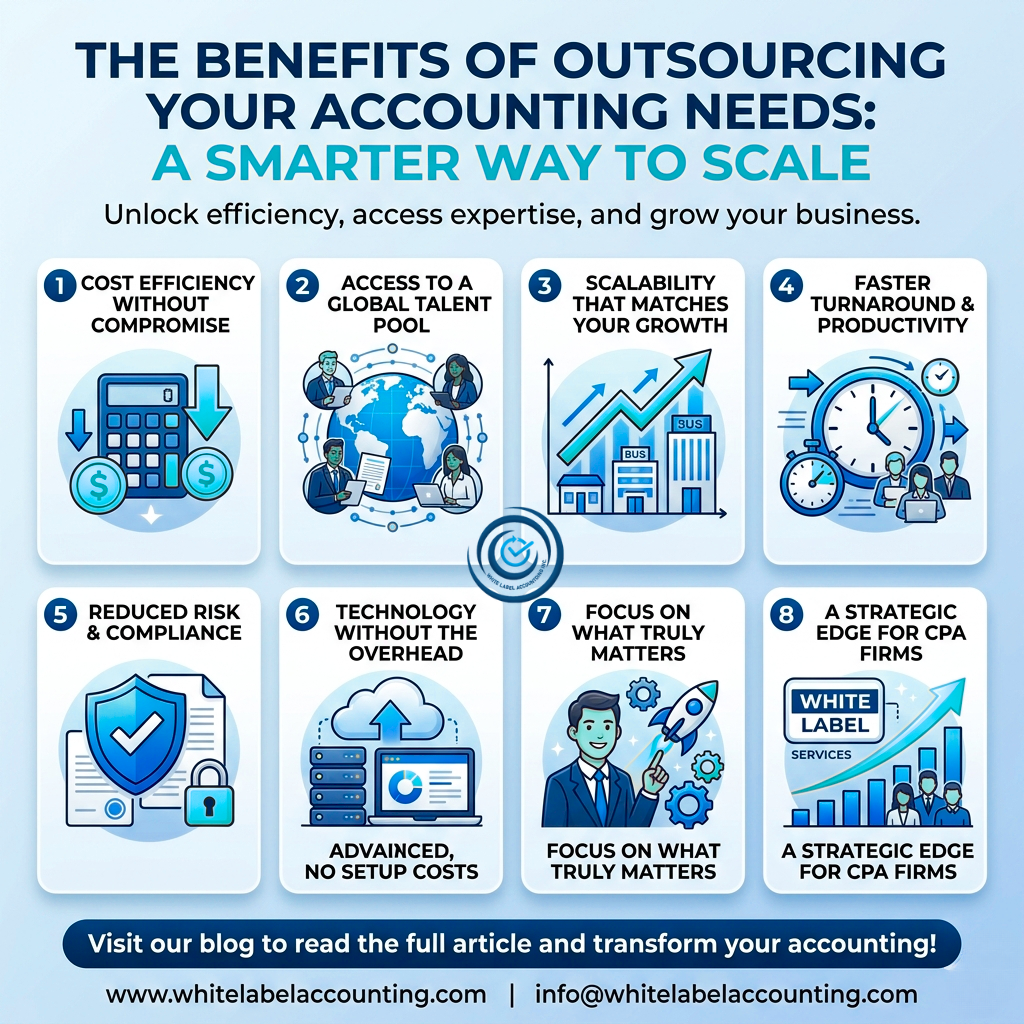
One of the most immediate benefits of outsourcing accounting is cost savings. Instead of bearing fixed costs like salaries, benefits, office space, and software licenses, businesses can convert accounting into a variable cost.
This means you only pay for what you need—whether it’s bookkeeping, tax preparation, or financial reporting—without sacrificing quality.
Outsourcing opens the door to highly skilled professionals with expertise across various accounting standards and industries. Rather than relying on a limited local talent pool, businesses can tap into specialists who are already trained in:
Financial reporting standards
Tax regulations
Audit support
Industry-specific accounting practices
This depth of expertise is often difficult (and expensive) to build internally.
Business growth is rarely linear. There are periods of rapid expansion, seasonal spikes, and unexpected surges in workload. Outsourced accounting services allow you to scale up or down instantly—without the delays of hiring or downsizing staff.
This flexibility is especially valuable for startups, SMEs, and CPA firms managing multiple clients.
With outsourced teams often working across different time zones, businesses benefit from near 24/7 operations. Tasks that would normally take days can be completed overnight, improving turnaround times and overall efficiency.
Internal teams can then focus on high-value activities like strategy, client relationships, and business growth.
Accounting errors can be costly—not just financially, but also in terms of reputation. Outsourcing partners typically have established processes, quality checks, and compliance frameworks in place.
This ensures:
Accurate financial records
Timely tax filings
Adherence to regulatory standards
Reduced risk of penalties and audits
Staying updated with the latest accounting software and tools can be expensive and time-consuming. Outsourcing providers often come equipped with advanced technology stacks, automation tools, and secure systems.
This gives businesses access to cutting-edge solutions—without investing in them directly.
Perhaps the most underrated benefit is focus. When accounting is handled externally, business owners and leadership teams can dedicate more time to innovation, customer experience, and scaling operations.
Accounting becomes a support function—not a bottleneck.
For CPA firms, outsourcing (especially white-label accounting) creates an opportunity to expand service offerings without increasing internal headcount. Firms can take on more clients, offer faster delivery, and improve profitability—while maintaining their brand identity.
Outsourcing accounting isn’t about replacing your internal team—it’s about enhancing your capabilities. It allows businesses to operate smarter, respond faster, and grow without being weighed down by operational complexities.
In a world where agility and efficiency define success, outsourcing your accounting needs might just be the smartest move you make.


Copyright © 2025 White Label Accounting Inc. All Rights Reserved | Developed by WITH U Technology Pvt. Ltd.