Inventory is the heartbeat of many businesses. Whether you run a retail store, an e-commerce brand, or a manufacturing unit, the way you track and manage inventory directly impacts your cash flow, profitability, and customer satisfaction. Yet, inventory mismanagement remains one of the most common challenges businesses face.
The good news? With the right systems, discipline, and accounting integration, inventory control can become one of your strongest business advantages rather than a constant headache.
Let’s explore how to manage it effectively in a modern, scalable way.
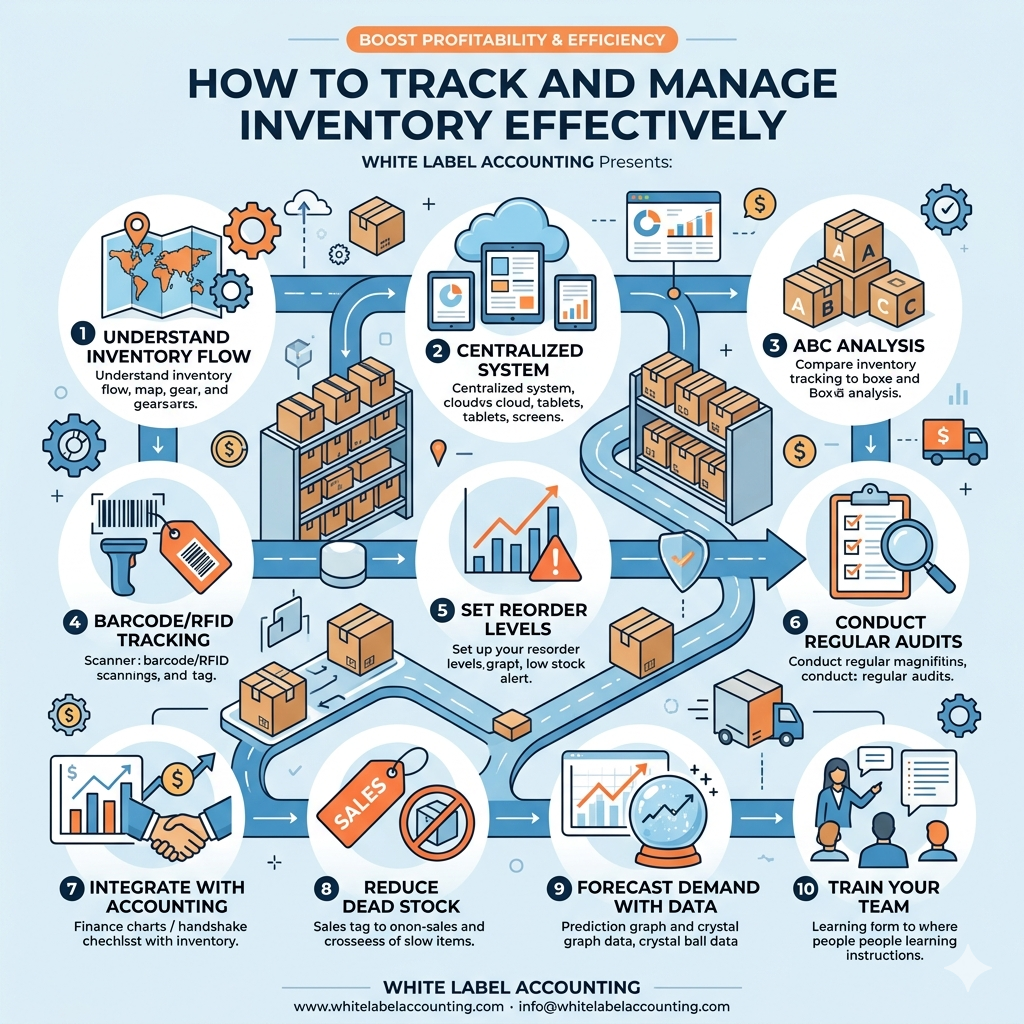
Before introducing tools or systems, you need clarity on how inventory moves within your business. This includes:
Purchasing or production
Storage in warehouses
Movement between locations
Sales or dispatch
Mapping this flow helps identify weak points like delays, overstocking, or leakage.
Relying on spreadsheets or manual logs often leads to errors and duplication. A centralized digital system ensures real-time visibility across all inventory levels.
Modern inventory systems help you:
Track stock in real time
Sync data across departments
Avoid duplicate entries
Monitor stock levels instantly
This creates a single source of truth for your business operations.
Not all inventory items hold the same value. A smart classification system helps you prioritize effectively:
A Items: High-value, low-quantity products
B Items: Moderate value and demand
C Items: Low-value, high-volume products
This allows better decision-making on purchasing, storage, and sales focus.
Manual entry increases the risk of human error. Barcode or RFID systems simplify tracking and improve accuracy significantly.
Benefits include:
Faster stock updates
Reduced manual mistakes
Easier stock audits
Improved warehouse efficiency
Even small businesses can adopt barcode systems at affordable costs today.
Running out of stock can lead to lost sales, while overstocking ties up capital unnecessarily.
Set clear reorder points based on:
Sales trends
Supplier lead times
Seasonal demand
Safety stock levels
Automation tools can alert you when inventory reaches reorder thresholds.
Even with automation, periodic audits are essential to ensure system accuracy.
Types of audits include:
Daily cycle counts
Monthly spot checks
Annual physical inventory audits
These help identify discrepancies early and maintain financial accuracy.
Inventory is not just operational—it’s financial. Poor integration can distort profit calculations and financial reporting.
When inventory is connected to accounting systems, you can:
Track cost of goods sold accurately
Monitor real-time profitability
Improve tax reporting accuracy
Maintain cleaner financial records
This is where accounting expertise plays a crucial role in business stability.
Dead stock ties up capital and occupies valuable storage space.
To manage it effectively:
Run periodic sales or discounts
Bundle slow-moving items with fast sellers
Analyze demand trends regularly
Avoid over-purchasing without data
Guesswork leads to overstock or shortages. Data-driven forecasting helps you plan smarter.
Use:
Historical sales data
Seasonal trends
Market demand patterns
Customer buying behavior
This ensures better purchasing decisions and smoother operations.
Even the best system fails without proper execution. Your staff must understand:
How to update inventory correctly
Why accuracy matters
How to use tracking tools
The impact of errors on finances
Consistency is built through training and accountability.
Effective inventory management is not just about counting stock—it’s about controlling business efficiency, cash flow, and profitability. When properly structured, it reduces waste, prevents losses, and strengthens financial decision-making.
Businesses that adopt modern inventory tracking systems and integrate them with accounting processes gain a clear competitive advantage.
With the right strategy in place, inventory becomes less of a challenge and more of a growth driver.




Copyright © 2025 White Label Accounting Inc. All Rights Reserved | Developed by WITH U Technology Pvt. Ltd.