Nobody likes getting a letter from the IRS, especially when it comes with a hefty bill for penalties and interest. IRS penalties can quickly turn a manageable tax obligation into a financial nightmare.
The good news? Most IRS penalties are completely preventable. With a little proactive tax planning, you can keep your hard-earned money where it belongs—in your pocket. Here is how you can stay on the right side of the taxman.
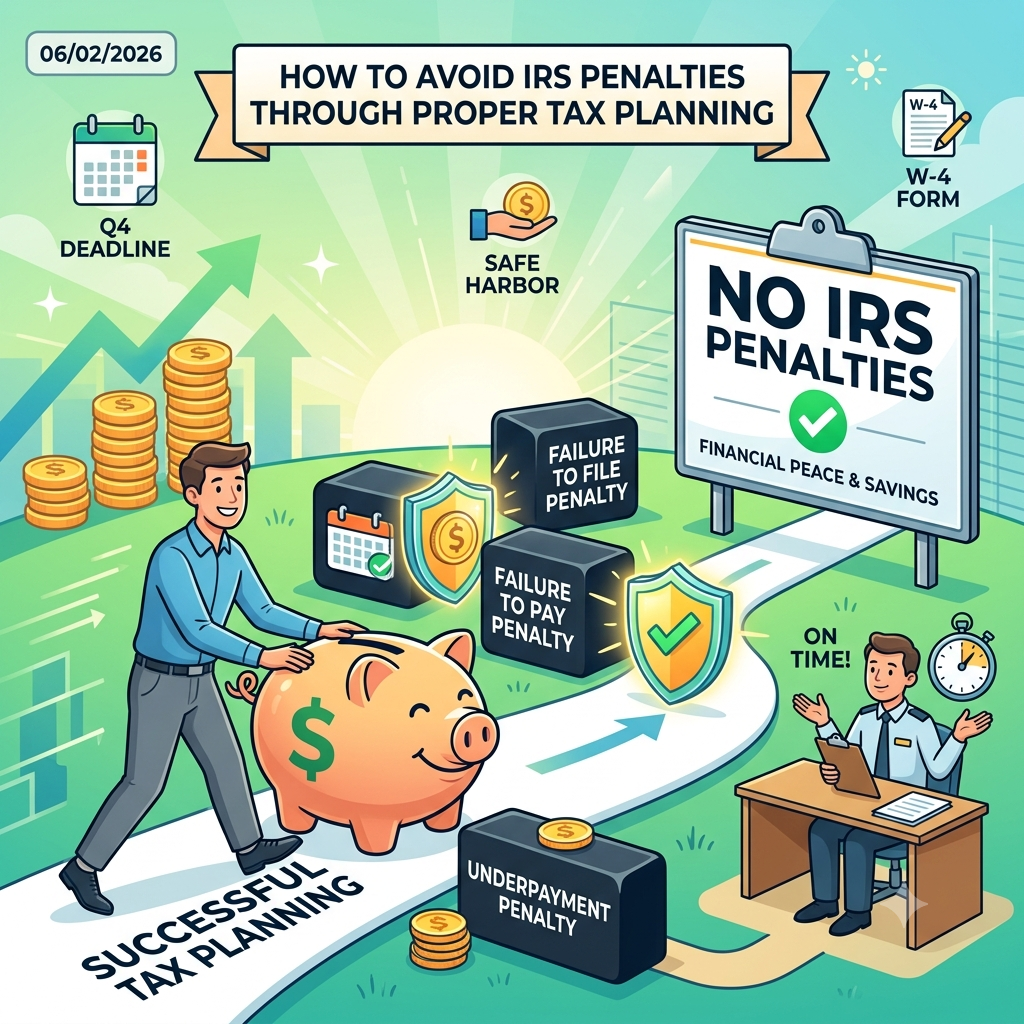
Before you can avoid penalties, you need to know what you’re up against. The IRS most commonly issues penalties for three specific infractions:
Failure to File: This happens when you don't submit your tax return by the due date. Ironically, this penalty is often much higher than the penalty for not paying.
Failure to Pay: This kicks in when you file your return but don't pay the taxes you owe by the deadline.
Underpayment of Estimated Tax: If you are self-employed, a freelancer, or have significant investment income, you must pay taxes quarterly. If you don't pay enough throughout the year, the IRS will penalize you.
Key Takeaway: Even if you can't afford to pay your taxes, always file your return on time. The penalty for failing to file is usually 5% of the unpaid taxes per month, while the failure-to-pay penalty is only 0.5% per month.
If your income isn't subject to automatic withholding (like a standard W-2 salary), you are responsible for sending the IRS a slice of your income every quarter.
To avoid the underpayment penalty, you should aim to meet the Safe Harbor rules. Generally, you won't face a penalty if you pay at least:
90% of the tax you owe for the current year, OR
100% of the tax showed on your return for the prior year (this jumps to 110% if your adjusted gross income is over $150,000).
Mark these dates on your calendar, as missing them means racking up interest:
Q1: April 15
Q2: June 15
Q3: September 15
Q4: January 15 (of the following year)
If you are a traditional employee and found yourself owing a large lump sum last tax season, your employer probably isn't withholding enough from your paycheck.
You can easily fix this by submitting a new Form W-4 to your HR department. Use the IRS Tax Withholding Estimator tool online to figure out exactly how much extra should be taken out of each paycheck. It’s an easy, "set-it-and-forget-it" way to avoid an underpayment penalty.
Life happens. If you can't get your paperwork together by the April deadline, you can file for an automatic 6-month extension using Form 4868. This pushes your filing deadline to October 15.
The Catch: An extension to file is not an extension to pay. You must estimate what you owe and pay that amount by the April deadline. If you don't, the failure-to-pay penalty and interest will start ticking.
An IRS audit can lead to accuracy-related penalties if you cannot back up the deductions, credits, or business expenses you claimed.
Use digital receipt-tracking apps.
Separate your personal and business bank accounts.
Keep your tax records for at least three to seven years, depending on your financial situation.
If you've already received a penalty notice, don't panic. If you have a clean track record of compliance for the past three years, you may qualify for the IRS First-Time Penalty Abatement. It never hurts to call the IRS (or have your CPA do it) and ask for relief.
The best defense against the IRS is a good offense. By planning ahead, keeping track of deadlines, and adjusting your withholdings, you can confidently navigate tax season penalty-free.



Copyright © 2025 White Label Accounting Inc. All Rights Reserved | Developed by WITH U Technology Pvt. Ltd.