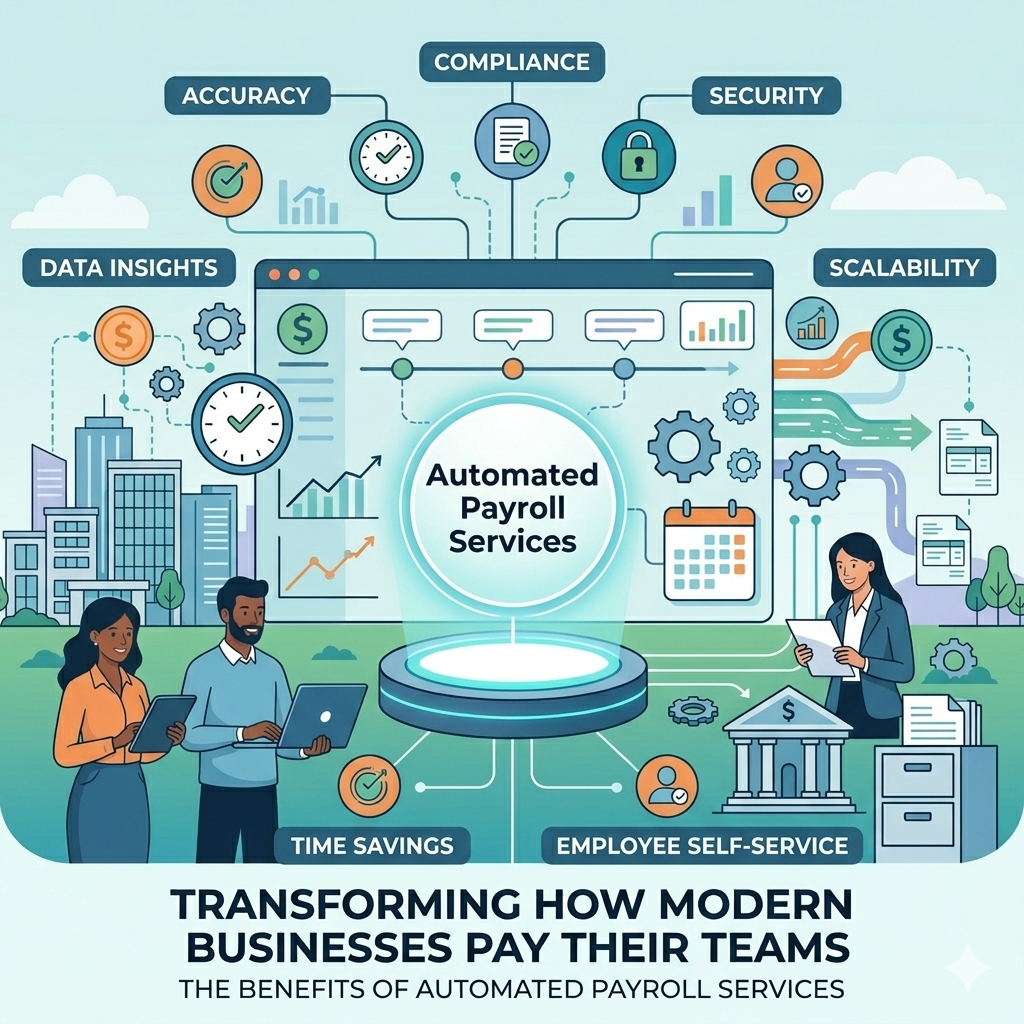
Payroll is one of the most critical responsibilities in any organization. Employees expect to be paid accurately and on time, while businesses must ensure compliance with tax regulations, benefits deductions, and reporting requirements. Yet for many companies, payroll remains a time-consuming and error-prone process when handled manually.
This is where automated payroll services are transforming the way businesses manage compensation. By integrating technology into payroll operations, companies can reduce administrative workload, minimize errors, and focus more on strategic growth.
In this article, we explore how automated payroll systems are reshaping payroll management and why more firms are turning to automation to streamline their financial operations.
Automated payroll services use specialized software to handle payroll calculations, tax deductions, compliance reporting, and payment processing with minimal manual intervention.
Instead of manually calculating salaries, taxes, and deductions, automation performs these tasks instantly using pre-configured rules and data integration.
Typical features of automated payroll solutions include:
Automatic salary calculations
Tax computation and filing
Employee self-service portals
Direct deposit payments
Compliance management
Payroll reporting and analytics
These features significantly simplify payroll management for businesses of all sizes.
As companies grow, payroll becomes more complex. Managing multiple employees, benefits, bonuses, tax obligations, and regulatory updates manually increases the risk of errors.
Automation helps organizations overcome these challenges by creating a reliable, scalable, and efficient payroll system.
Businesses adopting automated payroll often experience improved operational efficiency and better financial control.
Manual payroll processing involves collecting employee data, calculating hours, applying deductions, and preparing payments. This process can take several hours or even days each month.
Automated payroll systems perform these tasks within minutes. Once employee data and payroll rules are configured, the system handles calculations automatically.
This allows finance teams and business owners to dedicate more time to strategic business activities.
Payroll errors can create serious issues, including employee dissatisfaction and compliance penalties. Common mistakes in manual payroll include:
Incorrect tax calculations
Misapplied deductions
Data entry errors
Overtime miscalculations
Automated systems follow predefined rules and calculations, greatly reducing the risk of human error and ensuring employees are paid correctly.
Payroll regulations frequently change, making compliance a challenge for businesses. Missing tax deadlines or miscalculating payroll taxes can lead to costly penalties.
Automated payroll solutions help businesses stay compliant by:
Automatically updating tax rates
Generating required reports
Calculating tax deductions accurately
Assisting with payroll tax filings
This reduces compliance risk and provides peace of mind for business owners.
Automation dramatically speeds up payroll cycles. Instead of spending days verifying calculations and preparing payments, payroll can be completed quickly and efficiently.
Many systems also support:
Direct deposit payments
Scheduled payroll runs
Automated payslip generation
Employees receive payments faster and businesses maintain consistent payroll timelines.
Payroll data contains sensitive information such as salaries, bank details, and tax identification numbers. Storing and processing this information manually can increase security risks.
Automated payroll platforms typically offer advanced security features including:
Data encryption
Secure cloud storage
Access control permissions
Audit trails
These safeguards help protect confidential employee and financial data.
Modern employees expect transparency and convenience when it comes to payroll. Automated payroll systems often include employee self-service portals where staff can:
Access payslips
Download tax forms
Update personal information
Track leave balances
This improves employee satisfaction while reducing administrative workload for HR and finance teams.
Automated payroll services generate detailed reports that help businesses analyze payroll expenses and workforce costs.
These reports can provide insights into:
Department payroll costs
Tax liabilities
Overtime expenses
Employee compensation trends
Access to real-time data enables better financial planning and strategic decision-making.
As organizations expand, payroll complexity increases. More employees, multiple locations, and varying tax regulations can overwhelm manual systems.
Automated payroll solutions scale easily with business growth. New employees, departments, or locations can be added without significantly increasing administrative effort.
This flexibility makes automation ideal for growing businesses and accounting firms managing multiple clients.
Many accounting firms and businesses are combining automation with outsourced payroll services to further enhance efficiency.
Outsourcing automated payroll can offer advantages such as:
Expert payroll management
Reduced operational costs
Improved compliance monitoring
Access to advanced payroll technology
For accounting firms, white label payroll solutions also allow them to offer payroll services to clients under their own brand while maintaining operational efficiency.
Payroll automation is no longer just a convenience—it has become an essential tool for modern businesses seeking accuracy, efficiency, and compliance.
By adopting automated payroll services, organizations can streamline payroll operations, reduce administrative burdens, and ensure employees are paid accurately and on time.
As businesses continue to embrace digital transformation, automated payroll systems will play a key role in building smarter, more efficient financial processes.
For accounting firms and businesses alike, investing in automated payroll solutions is a strategic step toward better financial management and scalable growth.
Copyright © 2025 White Label Accounting Inc. All Rights Reserved | Developed by WITH U Technology Pvt. Ltd.